How a Car Works: From Starter Motor to Wheels
This explainer follows power through a car, from the battery and starter motor to combustion in the cylinders, the crankshaft, the transmission, the differential and the tyres. It uses a bicycle pedaling analogy for the crankshaft and compares low and high gears, then ends with the suspension, brakes and steering. It is made for curious general viewers and shown in the CAD Cutaway 3D style, with technical machinery in satin industrial blue and machined metal.
Technology CAD Cutaway 3D style
- Voice
- Tyler
- Language
- English
- Length
- 1:28
The brief
This is the brief that made the video. Start from it and change what you like.
Make a vertical (9:16) explainer of about 90 seconds on how a car works, for a general audience. Start with the driver turning the key, the battery powering the starter motor and the engine beginning to spin. Show fuel and air mixing in the cylinders, the piston compressing the mixture, the spark plug igniting it and the piston being forced down, thousands of times a minute. Explain how the crankshaft turns up and down motion into rotation, like pedaling a bicycle, then follow power through the clutch or torque converter and the gearbox, comparing low and high gears. Show the differential splitting power between the driven wheels and letting them turn at different speeds in corners, then the tyres pushing the car forward while the suspension, brakes and steering do their jobs. Use clear technical 3D cutaways of the machinery and an accessible, friendly narration.
The script
### [0:00–0:10] The Engine Starts
Ever wondered how a car actually works? Let's break it down. When you turn the key or press the start button, the battery powers a starter motor, which gets the engine spinning. And that's when the magic begins.
### [0:10–0:23] Combustion
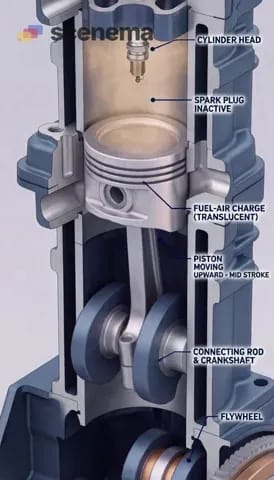
Inside the engine, fuel and air mix in the cylinders. The piston moves up, compressing the mixture, then the spark plug ignites it. This creates a mini explosion that forces the piston down. This process repeats thousands of times per minute.
### [0:23–0:35] Crankshaft
But here's the clever part. The pistons move up and down, while the crankshaft converts that movement into rotation. Think of it like pedalling a bicycle. Straight-line movement becomes spinning movement.
### [0:35–0:48] Gearbox and Transmission
That rotation travels through the transmission. Depending on the car, power passes through a clutch or torque converter before reaching the gearbox. Inside, different gear ratios control speed and pulling power. Lower gears give you more pulling force, while higher gears help maintain speed efficiently.
### [0:48–0:59] Differential and Wheels
Next, power reaches the differential, which distributes it between the driven wheels. It also allows the wheels to rotate at different speeds when you're turning a corner. Without it, turning would be a lot harder.
### [0:59–1:10] The Whole Car in Motion
Finally, the tyres grip the road and push the car forward. Meanwhile, the suspension absorbs bumps, the brakes slow the wheels down, and the steering system controls direction. And just like that, a series of controlled explosions has turned into a moving car!