How Frederic Tudor Sold New England Ice to the Tropics
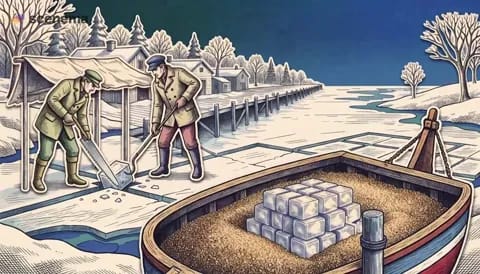
A business history documentary about Frederic Tudor and the early 19th century New England ice trade. It follows ice cut from frozen lakes to Martinique in 1806, the challenge of keeping a perishable cargo frozen while building demand, and the expansion to India in 1833. It ends on how Tudor made a product, a supply chain and new demand travel together. It is drawn in the Ink and Hatch Whiteboard style with bold cross hatched marker art and a few soft color washes.
History Ink and Hatch Whiteboard style
- Voice
- Clive
- Language
- English
- Length
- 1:42
The brief
This is the brief that made the video. Start from it and change what you like.
Make a 90 second landscape (16:9) historical business documentary for English speaking viewers interested in business history. Tell the story of Frederic Tudor's early 19th century New England ice trade: harvesting natural ice, his 1806 shipment to Martinique, the problems of transporting and selling ice in tropical markets, and the expansion to India in 1833. Focus on his decisions, risks, setbacks and opportunities, and do not invent conversations, events or financial figures. Show historically accurate clothing, tools, ships and ports, with consistent characters and varied physical action. Use a calm, mature documentary narrator and a bold hand drawn whiteboard look with cross hatching.
The script
What could New England sell to the tropics that would arrive frozen? In the early nineteenth century, Frederic Tudor made that question a business wager. His product was natural ice, cut from New England’s frozen waters. His market lay far beyond them.
In eighteen oh six, Tudor sent ice to Martinique. The cargo carried a challenge beyond distance: customers had to want an unfamiliar product, and the ice had to survive transport, reach buyers, and sell before it melted. Tudor had to solve insulation and shipping logistics while building demand and distribution in a tropical market.
The opportunity was clear, but the business was not. Ice that melted en route could not be sold. And one successful voyage would not create regular customers. Tudor faced setbacks as he worked to make the trade viable. He learned that exporting a perishable cargo required more than a ship and a destination. It required a way to protect the ice and a market ready to use it.
So the enterprise grew through two linked efforts: moving the ice, and teaching distant markets its value. In eighteen thirty-three, Tudor expanded the trade to India, extending the idea across an even greater distance.
The wager began with frozen water. Its real achievement was a market built around it. Tudor did not simply open a cargo route from New England. He made a product, a supply chain, and new demand travel together.