guides
Mayer's principles of multimedia learning for video (2026)
Contents: What is Mayer’s cognitive theory of multimedia learning?
Most explainer videos are designed to hold attention, but the techniques they use to do it often make the material harder to learn. A typical explainer plays background music under the narration, repeats every spoken word in captions, fills the frame with decorative motion and moves too fast for the viewer to stop and think. AI video tools can now produce all of this automatically, which makes it easy to publish a video that looks finished but teaches little.
Educational psychology has studied this problem for more than thirty years, most thoroughly through the work of Richard E. Mayer, a psychologist at the University of California, Santa Barbara. His cognitive theory of multimedia learning explains how people learn from words and pictures together, and his principles turn the theory into design rules tested in controlled experiments. The same research answers two questions many people making explainer videos ask today:
- Does an AI voice teach as well as a human one? Modern AI narration teaches as well as a human voice, and sometimes better.
- Does animation teach better than still pictures? Animation teaches somewhat better on average, and clearly better when the subject itself moves.
Mayer’s principles of multimedia learning are useful to anyone who makes educational videos: teachers recording lessons, trainers building onboarding and compliance courses, creators of online courses, and people running explainer channels on YouTube. Each principle below comes with a classroom example and a video example, so the research can be applied to a teaching video as easily as to a lesson.
What is Mayer’s cognitive theory of multimedia learning?
Mayer’s cognitive theory of multimedia learning holds that people learn more deeply from words and pictures together than from words alone, provided the lesson is designed around how the mind processes them. The theory rests on three assumptions:
- Dual channels: People process visual and pictorial material through one channel and spoken and verbal material through another.
- Limited capacity: Each channel can hold only a few pieces of information in working memory at a time.
- Active processing: Learning happens when people select the relevant words and images, organize them into coherent mental models, and connect those models with each other and with what they already know.
The third assumption describes five mental steps: selecting relevant words, selecting relevant images, organizing the words, organizing the images, and integrating both with prior knowledge.
Visual channel
Verbal channel
The theory also distinguishes three kinds of mental effort a learner spends during a lesson. A video on how the heart pumps blood shows each of them:
- Extraneous processing: Effort wasted on poor design, such as decoding clutter or searching the screen for the part the narrator means. In the heart video, this is attention spent on a music bed or on hunting for the chamber the narrator just named.
- Essential processing: Effort the material itself demands, which rises with how complex the topic is. Following blood through four chambers and two circuits takes work however well the video is made.
- Generative processing: Effort spent making sense of the material, which is the effort that produces deep learning. A viewer who works out why the left side of the heart has thicker walls than the right is doing generative processing.
Because working memory is limited, the three compete. A good lesson therefore reduces extraneous processing, manages essential processing, and fosters generative processing. Mayer groups his principles by these three goals.
Mayer set out the theory in book form in the first edition of Multimedia Learning (2001). The second edition (2009) set out the twelve principles that most summaries still teach, and the third edition (2020) added three more. His 2024 review in Educational Psychology Review looks back over the theory’s development and is free to read.
What are Mayer’s 12 principles of multimedia learning?
Mayer’s 12 principles of multimedia learning are the design rules in the second edition of Multimedia Learning (2009). The third edition, published in 2020, added three more principles, bringing the total to 15.
Reduce extraneous processing
Cut what wastes the viewer’s attention
- 1CoherenceLeave out words, pictures and sounds that do not serve the learning goal
- 2SignalingAdd cues that highlight the essential material and how it is organized
- 3RedundancyDo not show printed text that repeats the narration over a graphic
- 4Spatial contiguityPlace words next to the part of the picture they describe
- 5Temporal contiguityPresent narration and the matching picture at the same time
Manage essential processing
Help the viewer handle hard material
- 6SegmentingBreak a lesson into learner-paced parts
- 7Pre-trainingTeach the names and characteristics of key concepts first
- 8ModalityExplain a graphic with spoken words rather than printed words
Foster generative processing
Make the viewer want to understand
- 9MultimediaUse words and pictures rather than words alone
- 10PersonalizationUse a conversational style rather than a formal one
- 11VoiceNarrate in an appealing voice
- 12ImageA picture of the speaker on screen does not by itself improve learning
- 13EmbodimentOn-screen instructors and characters help when they gesture and move in human-like ways
- 14ImmersionHighly immersive media, such as virtual reality, do not necessarily teach better than on-screen video
- 15Generative activityPrompt learners to do something with the material, such as summarize, explain or draw it
Mayer reports that the experiments behind his own principles grew from 45 comparisons in 2001 to 93 in 2009 and 201 in 2020. The Cambridge Handbook of Multimedia Learning, which Mayer edits with Logan Fiorella, adds research by other scientists, including the findings on transient information, expertise and animation discussed below.
Mayer’s principles for reducing extraneous processing in a lesson or video
The five principles that target extraneous processing matter most for complex lessons, for lessons that play at a fixed pace, and for learners new to a topic. A video playing from start to finish is a fixed-pace lesson, so these five are the first ones an explainer video should get right.
Coherence principle in multimedia learning
According to the coherence principle, people learn better when extraneous words, pictures and sounds are left out. A fun fact, a decorative stock photo and a music bed all compete for the same limited attention as the explanation itself.
- Classroom example: A slide on how monsoon winds form shows a clear map of land and sea temperatures, without the photo of a crowded beach that served only as decoration.
- Video example: The narration explains the monsoon over the map alone, with no background music and no cutaway to unrelated travel footage.
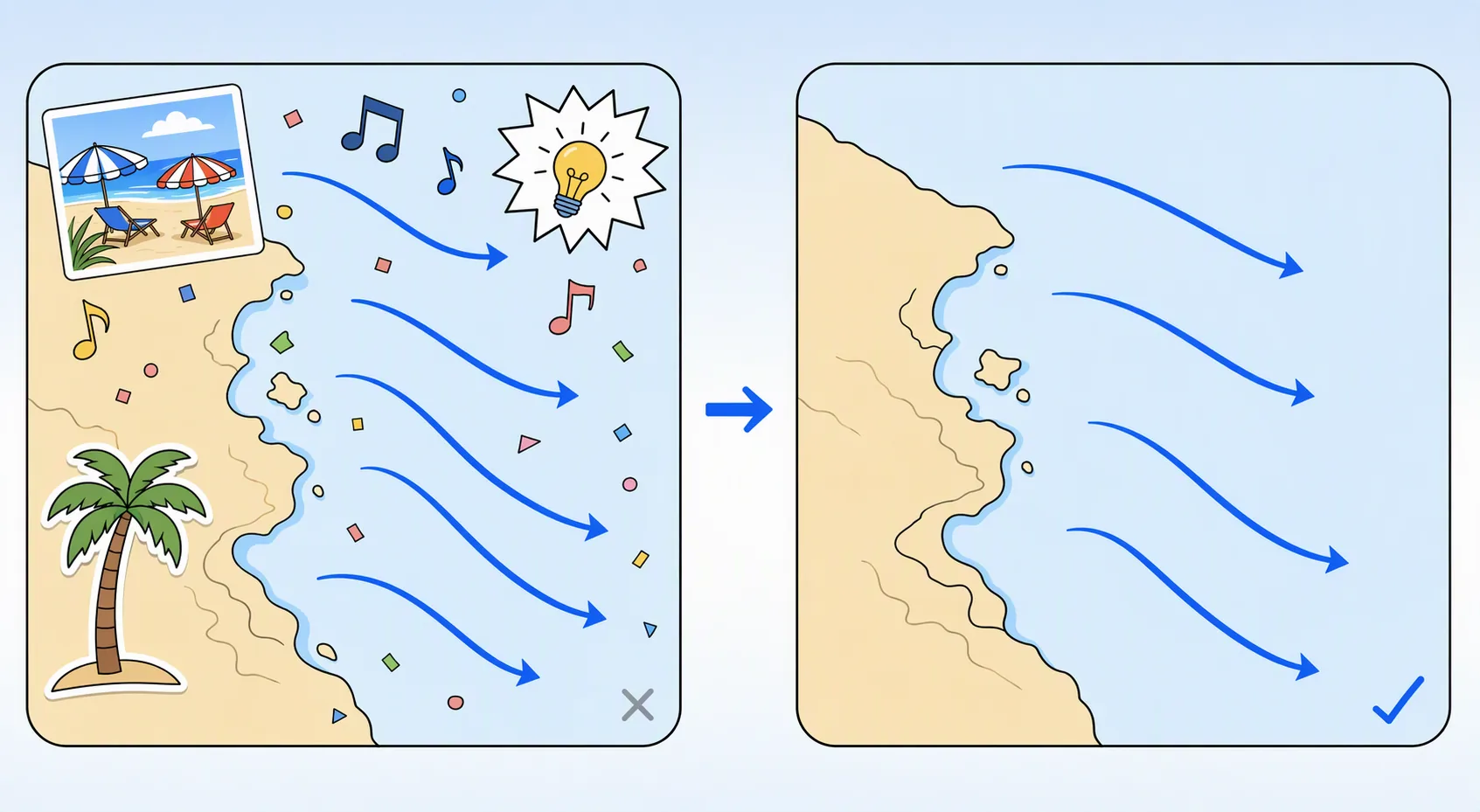
In experiments reported by Ruth Clark and Mayer, students who learned about lightning and car brakes without background music and sound effects scored between 61 and 149 percent higher than students who heard them, about twice as high on average. Interesting but irrelevant additions, which researchers call seductive details, lowered learning across dozens of studies, with the most harm for learners who have less working memory to spare.
Signaling principle in multimedia learning
The signaling principle states that people learn better when cues highlight the essential material and its organization. In a video, the viewer cannot see what matters most unless the design shows it.
- Classroom example: A diagram of a plant cell dims every part except the chloroplast while the teacher explains photosynthesis.
- Video example: A circle draws itself around the chloroplast at the moment the narrator names it, and a short heading marks the start of each new step.
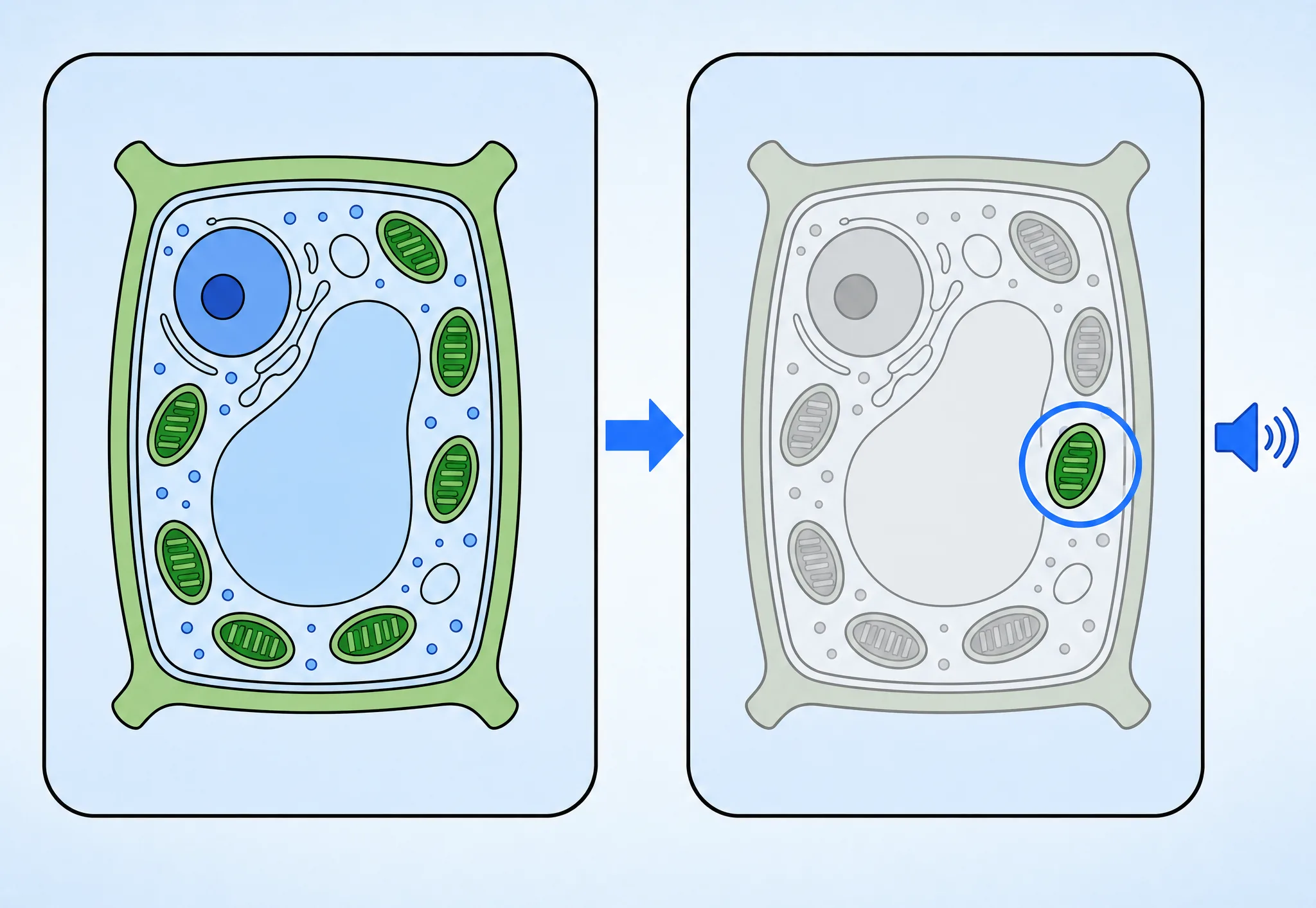
A review of 103 studies found that cues improved both how much learners remembered and how well they could apply it to new problems. Cues that link a word to its place in a picture helped beginners most and did little for learners who already knew the topic.
Redundancy principle in multimedia learning
Under the redundancy principle, people learn better from a graphic with narration than from a graphic with narration plus printed text that repeats it. Reading the text and watching the graphic both use the eyes, so the viewer has to split visual attention while the narration carries on.
- Classroom example: A teacher narrates an animated diagram of the water cycle without projecting the full script beside it.
- Video example: The video shows labels of two or three words on the diagram, not word-for-word captions of the narration burned into the frame.
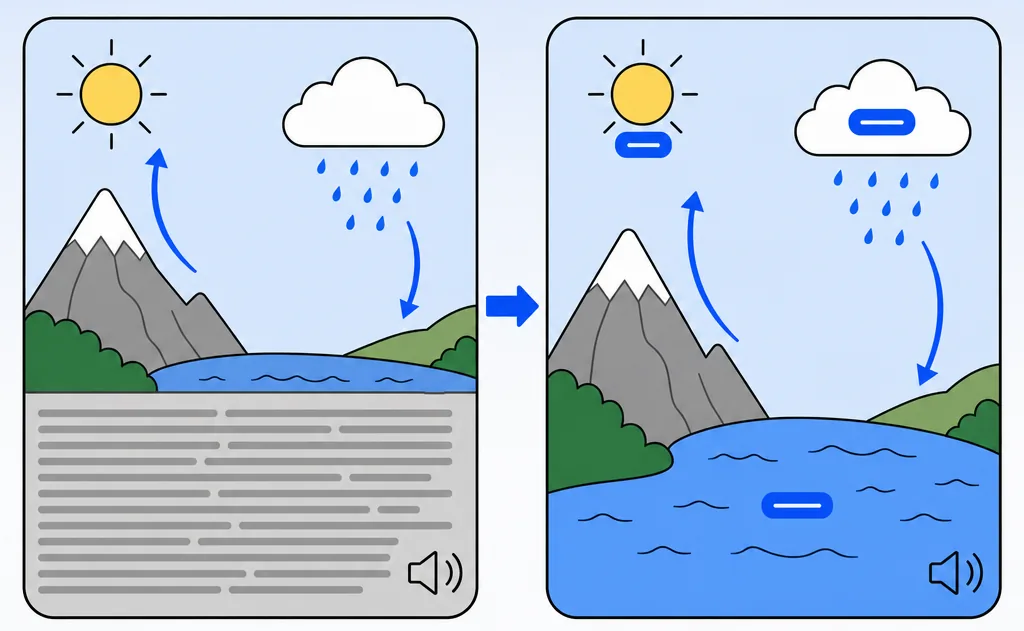
The redundancy principle has more exceptions than most summaries mention, and the Handbook calls a blanket rule to remove on-screen text “oversimplified.” Printed text helps learners watching in a second language, short key phrases help rather than hurt, and redundancy does less harm when viewers control the pace. Captions that a viewer chooses to switch on are a different matter from text designed into the frame, as the section on captions and accessibility below explains.
Spatial contiguity principle in multimedia learning
Spatial contiguity is the principle that people learn better when words sit next to the part of the picture they describe. A legend at the bottom of the screen forces the viewer to search back and forth.
- Classroom example: Labels for the parts of a volcano sit on the magma chamber, vent and crater, not in a numbered key below the drawing.
- Video example: Each label appears beside the part it names as the camera moves across the volcano.
Words in a separate key
- 1 Magma chamber
- 2 Vent
- 3 Crater
Words on the picture
Hover over or tap a label to highlight its part.
The principle applies when the words and the picture need each other to make sense, and it is one of the better supported in the Handbook.
Temporal contiguity principle in multimedia learning
Temporal contiguity, the timing counterpart of spatial contiguity, means people learn better when narration and the matching picture appear at the same time rather than one after the other.
- Classroom example: A teacher points to each chamber of the heart while describing it, rather than explaining the whole cycle first and showing the diagram afterwards.
- Video example: The animation shows blood entering the right atrium at the moment the narrator says so, not after the narration has finished.
The effect is strongest in fixed-pace lessons with spoken words, which is the format of most explainer videos.
Mayer’s principles for managing essential processing in complex material
Three of Mayer’s principles manage essential processing, the effort a hard topic demands however well it is designed, and a related finding explains why video makes that effort greater.
Segmenting principle in multimedia learning
People learn better, according to the segmenting principle, when a lesson comes in parts the learner can pace rather than as one continuous stream.
- Classroom example: A lesson on how a vaccine trains the immune system stops after each stage so students can ask questions.
- Video example: The video is divided into named chapters, and each chapter ends on a natural pause before the next stage begins.
Segmenting helped consistently in Mayer’s experiments, and a wider review of 56 comparisons found the benefit was larger when learners controlled the pace. In one set of experiments the benefit disappeared when viewers already had a pause button and a slider, which suggests that what matters is the chance to stop and absorb each part.
Pre-training principle in multimedia learning
Pre-training is the principle that people learn better when they already know the names and characteristics of the key concepts before the main explanation.
- Classroom example: Before explaining how a car’s brakes work, the teacher introduces the pedal, piston, brake fluid and brake pads one by one.
- Video example: A short opening scene names each part of the brake system with a label before the video shows them working together.
Pre-training helps beginners most and may do little for viewers who already know the parts.
Modality principle in multimedia learning
The modality principle states that people learn better from a graphic explained by spoken words than from the same graphic explained by printed words. Spoken words use the listening channel and leave the eyes free for the picture. Modality is the most studied of all the principles, and all 33 of Mayer’s foundational experiments found the effect.
- Classroom example: A teacher talks students through an animation of plate tectonics instead of asking them to read paragraphs beside it.
- Video example: The explainer narrates over the animation and keeps on-screen text to a few labels.
Printed words are the better choice for technical terms, for viewers learning in a second language, and for long or complex passages that a viewer may need to reread.
Why video is harder to learn from: The transient information principle
Spoken words and animation disappear as soon as they are delivered. The transient information principle, from the work of Dayu Jiang and John Sweller, holds that this can overload working memory, because the viewer must hold on to what has already gone while processing what is coming. In one experiment, short video sequences of a paper-folding task taught better than static pictures, but the advantage disappeared when the same content was shown in longer sequences.
A viewer can pause, rewind and replay a difficult step in any modern video player, and the research reports that several effects, including the harm from redundant text, shrink when learners control the pace. Learners do not always use those controls well, however. Studies of learner control found the clearest gains for people who already knew the topic, while pauses built into the lesson helped without hurting anyone, because the viewer does not have to judge when to stop. The practical lesson for a video maker is to keep each explained step short, end each step at a natural stopping point, and let viewers replay the hard parts.
Mayer’s principles for fostering generative processing
The remaining principles concern motivation: whether viewers treat a lesson as a conversation worth following.
- Personalization: A conversational style improves learning, with possibly weaker effects in lessons longer than 35 minutes. In a video, this means narration that addresses the viewer as “you” and explains as a good teacher would, the same voice that makes a YouTube video script easy to follow.
- Image: Showing the instructor’s face does not by itself improve learning. In one study students preferred seeing the instructor even though it lowered their comprehension. For example, a talking head earns screen time only when it adds something, such as a gesture toward the diagram.
- Embodiment: On-screen characters help when they gesture, make eye contact or point to what matters. Students new to a topic benefited most from an agent that gestured, while students with more knowledge learned better without one.
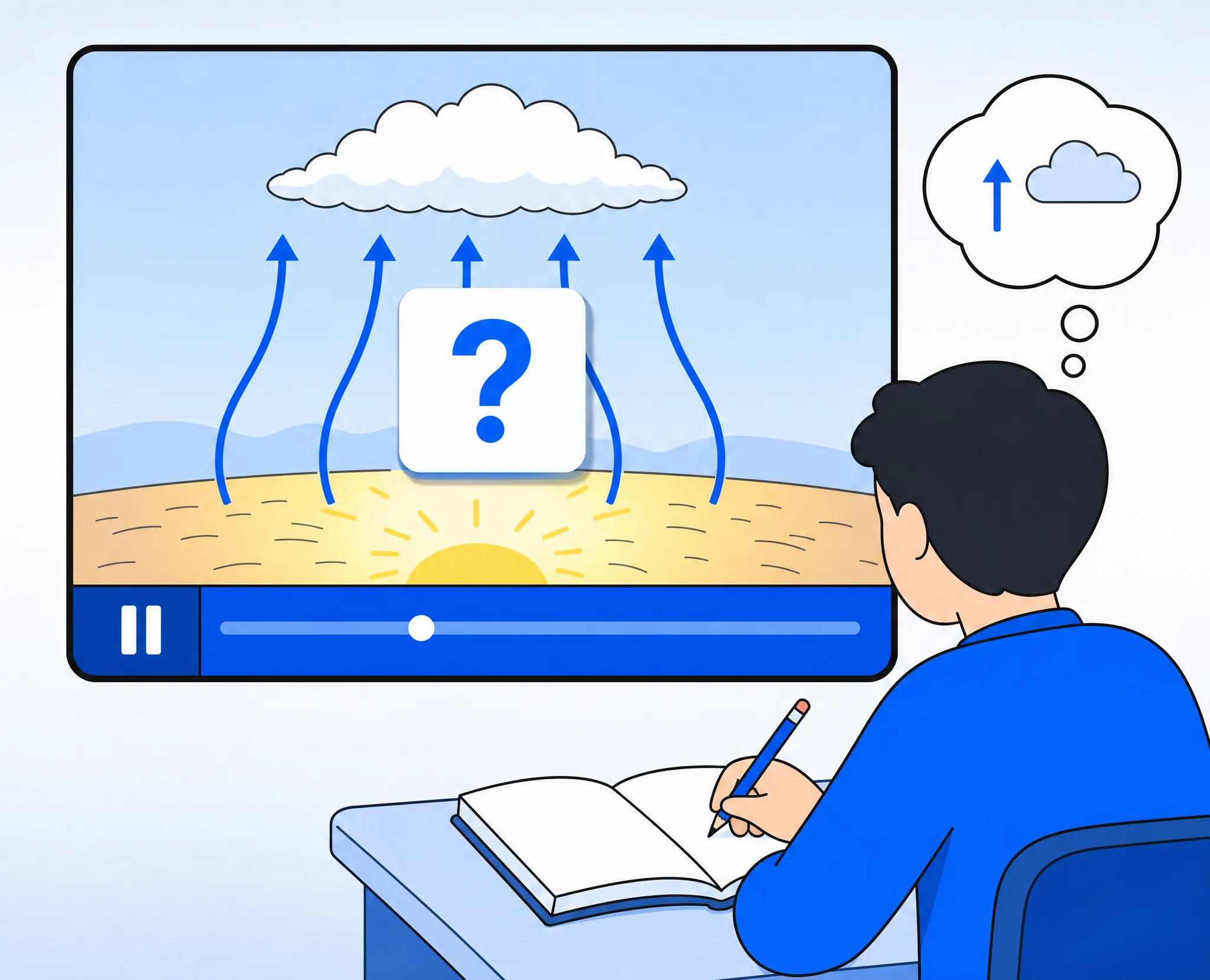
- Generative activity: Asking learners to do something with the material produces some of the most consistent results in the Handbook. Explaining the material to themselves helped in 44 of 54 experiments, and drawing it helped in 26 of 28. A video can prompt this with a pause and a question: “Before the next scene, explain to yourself why the air rises.”
How strong is the evidence for Mayer’s principles?
The table shows how much each principle helped in the research, measured as an effect size: The bigger the number, the bigger the benefit. Most figures come from short lab studies, so use them to compare principles rather than to predict what one video will do for a class.
How to read these numbersClick to open a short explanation of effect sizes.OpenClose
An effect size measures how much better one group did than another. If both groups’ test scores follow a bell curve, an effect size of 0.5 means the average learner who received the better design scored higher than about 69 percent of the learners in the study who did not. This conversion compares the two groups in a study, not the general population. Studies report it in one of two closely related forms:
- Cohen’s d: The difference between the two groups’ averages divided by their pooled standard deviation. It can slightly overstate the effect in small samples.
- Hedges’ g: The same measure with a small-sample correction, which makes it more accurate when groups are small or uneven in size.
The psychologist Jacob Cohen proposed reading 0.2 as small, 0.5 as medium and 0.8 as large, but his benchmarks came from short lab experiments. The education researcher Matthew Kraft found that effects measured with tests written for the lesson are often two to four times larger than effects on standardized tests in real schools, where he treats 0.20 or more as large.
Figures marked Mayer come from Mayer’s own experiments. The others come from reviews that combined studies by many research groups.
| Principle | What was found | Effect size |
|---|---|---|
| Multimedia | Words and pictures beat words alone in 13 of 13 tests (Mayer) | 1.35 |
| Modality | All 33 foundational experiments found the effect (Mayer); 0.65 across more than 75 comparisons | 0.88 |
| Pre-training | 26 tests, most favoring pre-training (Mayer) | 0.78 |
| Temporal contiguity | Review of early studies | 0.78 |
| Spatial contiguity | Review of 58 comparisons | 0.63 |
| Segmenting | Consistent benefit across 14 comparisons (Mayer); 0.36 in a review of 56 comparisons | 0.60 |
| Personalization | Review of studies on conversational style | 0.30 retention, 0.54 transfer |
| Signaling | Review of 103 studies | 0.53 retention, 0.33 transfer |
| Self-explaining (generative activity) | Helped in 44 of 54 experiments | 0.61 |
| Drawing (generative activity) | Helped in 26 of 28 experiments | 0.40 |
| Coherence (seductive details) | Review of 68 effects; adding irrelevant material lowered learning | −0.33 |
| Voice | Evidence described in the Handbook as limited; see the next section | Not reported |
Retention means remembering what was taught. Transfer means applying it to a new problem, which is the outcome Mayer treats as deep learning.
Does AI narration break Mayer’s voice principle?
Modern AI narration does not appear to break Mayer’s voice principle. The principle originally stated that people learn better from a human voice than from a machine voice, based on studies that used the robotic text-to-speech of the early 2000s, and the Handbook notes that the evidence for it was always limited.
A 2017 study by Craig and Schroeder compared three narrators for the same animated lesson on lightning: a classic text-to-speech voice, a modern text-to-speech voice and a human voice. Students who heard the modern synthetic voice did better on transfer tests and learned more efficiently than students in both other groups, and they rated it as credible as the human voice. Logan Fiorella and Mayer conclude that modern voice technology removes, and can even reverse, the original voice effect.
In a 2020 study, native English speakers learned less from a narrator with a strong unfamiliar accent, unless matching text accompanied the narration. The text helped them follow the words, although it brings back the cost described under the redundancy principle.
When you make a video in Scenema, you can choose the narrator’s language and accent to suit your learners, and add captions for an audience that will be watching in a second language.
How do captions and accessibility fit with Mayer’s principles?
Captions and Mayer’s principles fit together once two kinds of on-screen text are kept apart. The redundancy studies tested text designed into the frame and shown to every learner, often full paragraphs competing with a graphic in a fast lesson. Captions are a layer the viewer controls, and for many viewers they are the only way into the narration.
Many people watch with the sound off, on a train, in an open office or late at night, and follow the video entirely through its captions. For viewers who are deaf or hard of hearing, captions are essential. The World Health Organization estimates that 430 million people live with disabling hearing loss, and the Web Content Accessibility Guidelines (WCAG 2.2), the international standard for accessible web content, require captions for prerecorded video at their most basic level of conformance.
Captions also help viewers who can hear, because seeing the words while hearing them makes unfamiliar terms, fast speech and strong accents easier to follow. In a review of more than 100 studies, the psychologist Morton Ann Gernsbacher found that captions improved comprehension, attention and memory for children, students and adults, with the largest gains for people watching in a second language, people learning to read, and viewers who are deaf or hard of hearing. That fits the Handbook’s own exceptions to the redundancy principle, which note that printed text helps second-language learners and does less harm when viewers control it.
Blind and low-vision viewers need the reverse: The same guidelines ask for an audio description or a text alternative of what is shown, which a script can largely provide by having the narration name the key visuals as they appear. On a web page, descriptive alt text does the same job for each image.
The practical rule for an explainer video is to keep text designed into the frame to a few labels, offer captions on every video, and write narration that describes what matters on screen.
Do animated videos help students learn more than static pictures?
Animation helps learning somewhat on average, and helps clearly when the topic itself is about change over time. The Handbook summarizes four large reviews that compared animations with static pictures:
| Review | Studies compared | Result | Effect size |
|---|---|---|---|
| Höffler and Leutner (2007) | 26 studies, 76 comparisons | Animation better | 0.37 |
| Berney and Bétrancourt (2016) | 66 studies, 140 comparisons, 7,036 learners | Animation better | 0.22 |
| Castro-Alonso, Wong, Adesope and Ayres (2019) | 46 studies, 82 comparisons, 5,474 learners | Animation better | 0.23 |
| Ploetzner, Berney and Bétrancourt (2020) | Re-analysis of the 2016 data | Animation better when it shows complex change, such as speed or acceleration | 0.64 |
An effect size of 0.37 means the average learner who watched the animation scored higher than about 64 percent of learners who saw static pictures. When the animation showed how something changes over time, the advantage was close to three times as large. Clark and Mayer reach a cautious conclusion for workplace training: A series of still frames can explain how a system works as well as or better than an animation, while animation is the better choice for showing hands-on procedures.
A 2019 study in two Indonesian primary schools gave fifth graders motion graphic videos on the properties of light, while a comparison class learned from two-dimensional pictures. Both classes started with similar test scores, and the video class finished higher, with an average of 71.7 out of 100 against 65.7. The video lessons also included group discussion and the classes came from different schools, so the study shows that a well-planned video lesson can work in a real classroom without isolating what the animation itself contributed.
For AI-animated explainer videos, the conclusion is to use motion where the subject moves, such as a process, a sequence or a change, and to let still, clearly labeled frames carry concepts that do not move.
When do Mayer’s principles not apply?
Mayer’s principles do not apply equally to every learner and every lesson. The research identifies several conditions that matter for video:
- Prior knowledge: Most principles help beginners much more than experts. Slava Kalyuga’s work on the expertise reversal effect shows that support which helps a beginner, such as extra explanation or on-screen text, can slow down an expert who no longer needs it.
- Pacing: Many effects are strongest when the lesson plays at a fixed pace and weaker when the viewer can pause, rewind and reread.
- Language: Printed words help viewers learning in a second language, which reverses parts of the redundancy and modality principles for global audiences.
- Complexity: The principles matter most for complex material. A simple message survives poor design that would sink a difficult one.
- Age: Many of the experiments behind the principles were run with college students and adults in short lessons, with fewer in schools. The conditions the research identifies concern prior knowledge, pacing and language rather than age, and the expertise reversal effect has been found from primary school to university. Children who are still learning to read are the clearest exception, since captions and printed words help them build reading skills.
Each video therefore needs a defined audience before the principles can be weighed, because the same design choice can help a beginner and slow down an expert.
Popular ideas about multimedia learning that research does not support
The Handbook reviews fifteen common beliefs about multimedia instruction that the evidence does not support. Click or tap each card to see what the research found.
How to apply Mayer’s principles to an animated explainer video
Tick each item as you plan or review a video. The same checklist helps when you choose an AI educational video generator.
Mayer’s principles checklist for an animated explainer
When you make an animated explainer in Scenema, the video starts as a script divided into scenes and shots, so chapters, a pre-training scene and short explained steps can be planned before anything is rendered. Scenema adds no background music and no text over the frame, so coherence and redundancy start in good shape, and captions are there for learners who need them.
Turn your lesson into an animated explainer
Start from your script or lesson notes. Scenema plans the scenes, narrates them and keeps your characters and style consistent from the first shot to the last.
The TL;DR on Mayer’s principles of multimedia learning
What is Mayer’s cognitive theory of multimedia learning? The cognitive theory of multimedia learning is Richard Mayer’s account of why people learn more deeply from words and pictures than from words alone: They process the two through separate, limited channels and must actively connect them.
How many principles of multimedia learning are there? Mayer’s Multimedia Learning lists 15 principles in its third edition (2020), the 12 from the second edition (2009) plus embodiment, immersion and generative activity. The Cambridge Handbook of Multimedia Learning covers more, because it includes principles studied by other researchers.
What is the most important principle of multimedia learning? The multimedia principle has the strongest evidence from Mayer’s own experiments: Words and pictures beat words alone in 13 of 13 tests. For narrated video, the coherence, modality and segmenting principles have the most practical impact.
What are the key principles of multimedia design? The key principles of multimedia design are to cut anything that does not serve the learning goal, highlight what matters, explain graphics with narration rather than printed text, place words close to the pictures they describe, break lessons into parts, and write in a conversational style.
What is the difference between the redundancy principle and the modality principle? The modality principle compares narration with printed text as the way to explain a graphic and favors narration. The redundancy principle concerns adding printed text that repeats the narration and advises against it in most cases.
Who should use Mayer’s principles of multimedia learning? Anyone who makes educational videos can use Mayer’s principles, including teachers recording lessons, corporate trainers, online course creators and YouTube creators who run explainer channels. The principles describe how viewers learn from words and pictures, whatever the platform.
How can Mayer’s principles improve an animated or faceless YouTube explainer channel? Mayer’s principles make an animated or faceless explainer easier to understand. Narrate over the visuals instead of filling the screen with text, drop the music bed under the voice, highlight what the narrator names, split the video into chapters, and offer captions for viewers watching with the sound off. The research measured how much viewers learned rather than how long they watched, so treat the principles as a guide to clarity, not a promise of more views.
Do Mayer’s principles apply to children as well as adults? Mayer’s principles apply to learners of all ages, although much of the research was done with college students and adults. What changes the effect is prior knowledge, pacing and language rather than age, and children who are learning to read gain more from captions and printed words than adults do.
Do Mayer’s principles apply to videos and slide presentations? Mayer’s principles apply to any lesson that combines words and pictures, including videos and slide presentations. They matter most in video, because a video plays at a fixed pace unless the viewer stops it.
Is AI narration compatible with Mayer’s voice principle? Research described in the Handbook found that a modern text-to-speech voice taught as well as or better than a human voice, while a strong unfamiliar accent made narration harder to follow.
Do captions break Mayer’s redundancy principle? Captions do not break Mayer’s redundancy principle when the viewer controls them. The redundancy research tested text designed into the frame, while captions help viewers who are deaf or hard of hearing, watching with the sound off or learning in a second language, and a review of more than 100 studies found they improve comprehension for most viewers.
Is there a PDF version of Mayer’s principles of multimedia learning? Mayer’s 2024 review article, “The Past, Present, and Future of the Cognitive Theory of Multimedia Learning,” is open access and free to download as a PDF from Educational Psychology Review. His books Multimedia Learning and The Cambridge Handbook of Multimedia Learning are published by Cambridge University Press.
About the author
Karishma Mhapadi holds a master’s degree in International Education Policy from the Harvard Graduate School of Education and a bachelor’s degree in psychology and sociology. She has worked on education and learning projects in international development with organizations including UNICEF, the World Bank, the African Development Bank, BRAC and GIZ. At Scenema she writes about how people learn from video and how to make explainers people understand and remember.
References and further reading
- Mayer, R. E. (2020). Multimedia Learning (3rd ed.). Cambridge University Press.
- Mayer, R. E., & Fiorella, L. (Eds.). (2022). The Cambridge Handbook of Multimedia Learning (3rd ed.). Cambridge University Press. Chapters drawn on: Mayer and Fiorella (introduction; extraneous processing; essential processing; social cues), Feldon, Jeong and Clark (questionable principles), Mayer (multimedia principle), Kalyuga (expertise reversal), van Gog (signaling), Jiang and Sweller (transient information), Lowe, Schnotz and Boucheix (animation), Fiorella and Mayer (generative activity).
- Mayer, R. E. (2024). The past, present, and future of the cognitive theory of multimedia learning. Educational Psychology Review, 36, 8. Open access
- Clark, R. C., & Mayer, R. E. (2016). e-Learning and the Science of Instruction (4th ed.). Wiley.
- World Bank (2021). Remote Learning During COVID-19: Lessons from Today, Principles for Tomorrow. PDF
- Gernsbacher, M. A. (2015). Video captions benefit everyone. Policy Insights from the Behavioral and Brain Sciences, 2(1), 195–202. doi:10.1177/2372732215602130
- World Health Organization (2026). Deafness and hearing loss fact sheet. who.int
- W3C (2023). Web Content Accessibility Guidelines (WCAG) 2.2, success criteria 1.2.2 Captions (Prerecorded) and 1.2.3 Audio Description or Media Alternative (Prerecorded). w3.org
- Kraft, M. A. (2020). Interpreting effect sizes of education interventions. Educational Researcher, 49(4), 241–253. doi:10.3102/0013189X20912798
- Cohen, J. (1988). Statistical Power Analysis for the Behavioral Sciences (2nd ed.). Lawrence Erlbaum.
- Hapsari, A. S., Hanif, M., Gunarhadi, & Roemintoyo. (2019). Motion graphic animation videos to improve the learning outcomes of elementary school students. European Journal of Educational Research, 8(4), 1245–1255. doi:10.12973/eu-jer.8.4.1245
Related Scenema reading
- What is a long-form explainer video? defines the format these principles are applied to.
- How to write a YouTube video script covers writing narration that explains.
- How to make a 6-minute AI explainer video from a short prompt walks through a full AI-animated explainer.
- What is AI animation? explains how AI turns text into animated video.